
A candidate who can explain the SAP kernel, support packages, and SPAM is a good start when reviewing Basis interview questions. But to test whether someone is ready to work in production, you have to look for more than memorized answers.
When I interview potential candidates for an SAP Basis Administrator role, I’m not really interested in testing whether they understand all the theoretical underpinnings of their job title. Yes, there’s plenty of that, like the SAP kernel, or the differences between support packages, SAP Notes, and kernel updates. But if the candidate doesn’t understand what a table like T000 does — and how it connects with the system — then they probably aren’t ready for production responsibilities.
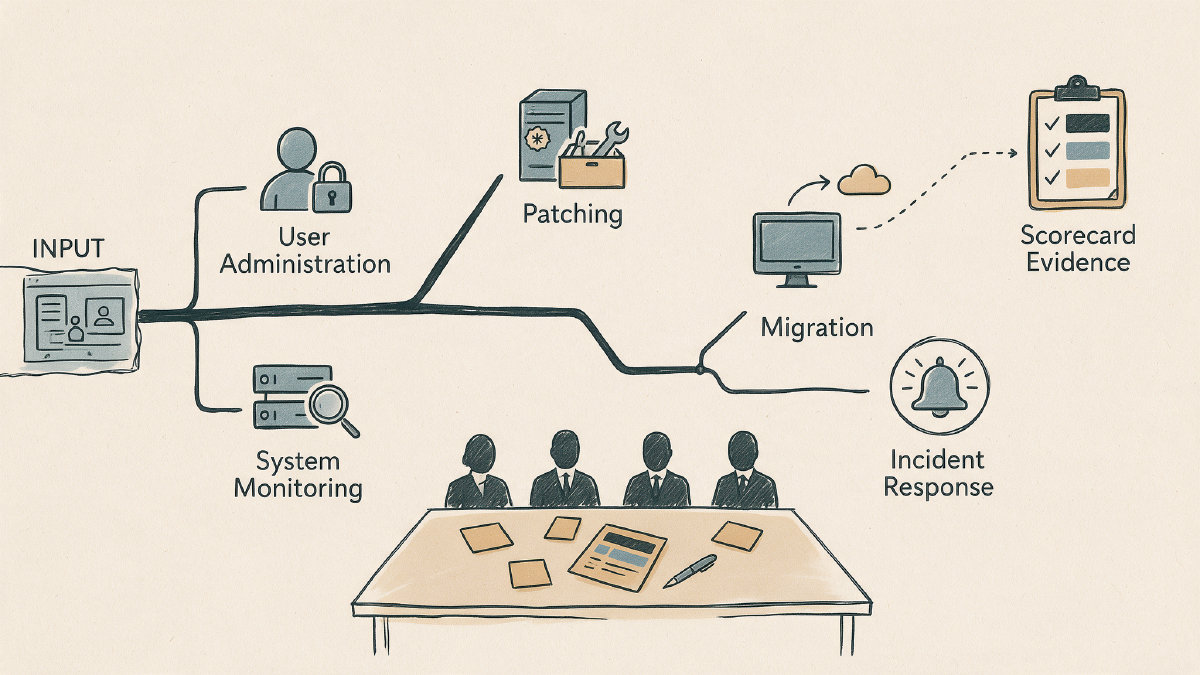
In other words, you need to test your candidate against a concrete system event, a tool, a decision, a verification, and a result. You’ll see them fail in the abstract, but pass when put into a specific situation. This approach gives them the chance to prove themselves. In addition, this method prevents companies from hiring “yes” men who simply recite back what they think they’re supposed to know.
I’ve written down a set of questions that help me find the best Basis Admins. They may not be the only questions you should use; after all, interviews are often about getting to know a person rather than just evaluating knowledge. Still, they’re worth considering.
Recommended Basis Interview Questions
Here’s my recommended question list for the SAP Basis interview, mapped out according to depth and role:
What are clients, and how do you maintain client-specific settings? T000 is the SAP client table, so ask what client-specific settings and information they would check there.
How do you perform runtime diagnostics? Ask whether they have used developer traces to troubleshoot and debug runtime behavior, performance, and functionality. What does the term performance mean in the context of SAP Basis administration?
What tools exist to aid in maintenance, such as SDM, SUM, etc.? What do each of these accomplish?
Can you walk through creating or changing a user via SU01? Do you understand the identity information and validity associated with a user? Can you change the type of user and assign roles based on the user’s responsibilities?
Do you know why login failures occur, and how do you verify that a login failure is due to account issues, authorization issues, network issues, or some other system-level problem?
Support Package, SAP Note, and kernel: How do these three items differ? If I needed to correct an issue, which one would apply? If I wanted to update the system, which would apply? If I wanted to enhance functionality, which would apply?
If you were asked to perform a SUM event, what would you do? Why would you choose that source/target release? Why would you choose that version of SUM? Why would you choose that path (maintenance vs. migration)? Would you plan for downtime? What about transports? Would you monitor it during the event? How would you validate its success? Could you roll it back?
Are there any changes in RISE with SAP that would affect your role as a SAP Basis Administrator?
The last question is key, as many people assume that moving to cloud-based environments would eliminate traditional Infrastructure as a Service (IaaS) concerns. It won’t. Rather, you’ll share responsibility with the vendor for certain aspects, but not others.
Use this rubric to rate your candidates
Once your interview has wrapped up, score your candidate using this rubric:
Technical accuracy – Are they able to describe a topic accurately and concisely?
Hands-on ownership – Have they shown that they own a process, or have they simply explained how to perform tasks that they don’t believe they should be held accountable for?
Diagnostic method – Do they show a systematic approach to diagnosing problems, or do they make arbitrary assumptions about a problem without sufficient evidence?
Production risk – Do they demonstrate awareness of how to prevent or mitigate production risks?
Change risk – Do they consider the impact that a change will have on the system before implementing it?
Tool and transaction knowledge – Do they demonstrate familiarity with the tools and transactions used within the SAP Basis Administrator role?
Incident communication – Do they describe an incident in terms of evidence, and how did they resolve it? Or do they talk about incidents generally, without showing evidence?
Evidence specificity – Do they provide examples of incidents, or are they generic? Is the evidence tied to a particular product, system, and business function?
Remember, the goal is to ensure that your candidate isn’t merely listing the tools that they know. If they give you a list of names, you’re likely going to want to ask more questions, because memorizing those names doesn’t necessarily translate into real-world capabilities.
Instead, ask for evidence of how the candidate has successfully navigated an issue, made a decision, or verified that a task was completed. Contrast that with someone who might answer your question by simply listing off a bunch of SAP-related tools, knowing that you’re looking for them, but lacking the evidence to back up their response.
And finally, remember that there’s nothing wrong with asking your candidate to go back to the drawing board, or even telling them to leave the room. There’s no benefit in forcing them to say something that they aren’t prepared to say.