
One of the more subtle yet critical skills that you can hone is how to ask open ended questions during a hiring interview. This is something of a “soft” skill, and it’s one that many people think they already know how to do. Unfortunately, this isn’t always true.
An open ended question is any question which invites the candidate to provide some sort of story, explanation, or reasoning. The idea is that rather than having the interviewee simply confirm yes/no facts, they’ll describe a behavior, scenario, or strategy. In other words, they’ll talk.
Command-style prompts can also work just fine without an interrogative form: “Tell me about…”; “Walk me through…”. Or you could even use a free-form text answer as your prompt. (Note: these are commands, but they act as open-ended questions.)
Open Ended Questions Have Payoff
There’s another difference between open-ended and closed questions: the first gather context, motivation, behavior, reasoning, and even unexpected evidence. Closed questions confirm small facts. Overusing them will make the interview feel surface-level, like you’re asking the same few questions for every candidate. It’s better to ask fewer, but longer detailed responses.
You might be thinking: “Why would I ask a behavioral question?” Because there’s a lot you can learn about a person from what motivates them, their behaviors, and the mental models that shape how they see problems and how they solve them. If you ask the right question, you can discover whether the person has demonstrated good problem-solving strategies in past experiences. You can also find out if they understand how to communicate, clarify, and explore further detail.
In addition, when someone tells you a story, they’re going to explain it in the order that makes sense to them. If you then follow up by asking questions to clarify what they mean, expand on their story, or ask them about specific actions or timing, you can gain greater insight into both their experience and mindset.
The key is to phrase the question neutrally, with specificity, and with a neutral tone. When we asked about why a candidate left a previous employer, we were essentially suggesting that something was wrong with that position — hence, prompting a defensive response. But using “what” or “how” stems works well. And “walk me through [how/what]…” or “tell me a bit about…” are great phrases to help candidates describe the situation and process. As an interviewer, treat all of those phrases as neutral questions and avoid using leading language that implies you have some expectation or preference.
Converting Role Competencies to Interview Questions
To help you create interview questions, consider taking a structured approach to hiring. Start by defining the role and analyzing what it requires. Then identify what competencies are required for success, and what’s critical to the job. Once you’ve done that, take each role competency and turn it into one standardized question, or set of standardized questions, to determine proficiency levels against predefined criteria. Make sure that you anchor each lead question and probe question to a specific past experience or realistic work scenario, keeping the same question for every candidate.
For example, let’s say that we want to know how the candidate approaches new challenges. We’d start with a behavioral question, asking them to describe a time when they faced a challenge. From that, we might generate a second question that asks the candidate to walk us through their approach to dealing with a challenge.
This approach gives you the opportunity to adapt examples to your target competency rather than trying to offer a generic list of questions to ask each candidate. It also helps you ensure that you’re evaluating candidates using the same set of predefined questions, using the same scoring benchmarks and evaluation criteria. Behavioral description questions ask candidates to describe past behavior in a relevant situation. Situational questions ask how they would handle a realistic job scenario.
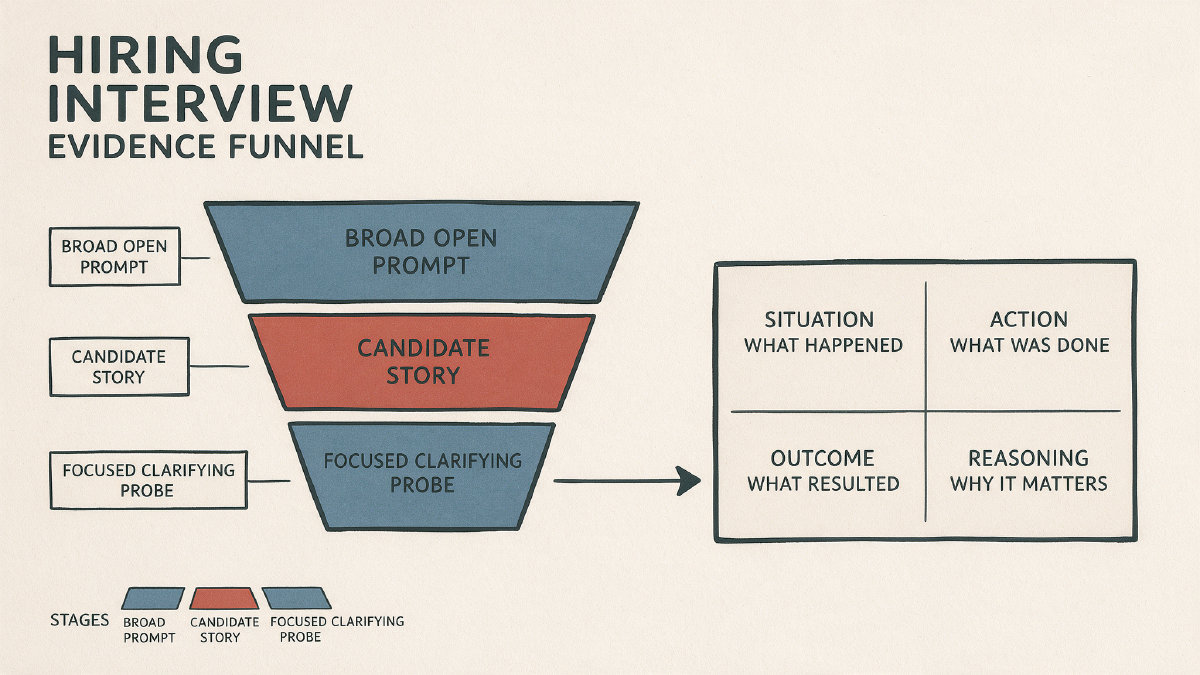
After you ask a broad question, invite the interviewee to tell you more about that topic, to expand upon it, or to clarify its meaning. Once the candidate answers, you’ll want to ask specific questions to dig into the details: What did they do? How long did it take? Did they succeed? What was their reasoning?
When converting resume claims into questions, you should ask yourself: What is it that you want to know about the candidate? Is it the situation? What were they doing? What actions did they take? What was the impact? And how did they reason through solving the problem? All of these elements can become part of a scorecard that will measure the candidate’s proficiency at a given competency.
A Weak Answer Isn’t an Automatic Rejection
If a candidate doesn’t answer, or responds vaguely, there may be a number of reasons for that. Vague answers are often generalizations or unsupported opinions. Other times, a candidate may be implying something without actually stating it directly. Either way, it’s a signal that you need to probe further rather than automatically reject a candidate. Similarly, a candidate who tells you a story that seems disconnected from the target competency is a sign that you need to dig deeper. Use a funnel: start broad with open-ended questions, then use narrow closed questions sparingly for dates, counts, timing, yes/no facts, or other clarifying details for your notes.
Asking open-ended questions may sound easy enough, but it takes time to master. Like anything else, you’ll need to practice asking them. You’ll also need to evaluate how well the candidate responded and how much information they provided. Only once you’ve mastered this skill will you truly understand the value of open-ended interviews.