
Jieyi's guide to screening questions, with a focus on signals, scorecards, and how to ask them.
I’ve written before about the importance of early screening. Here’s a sample of what I think a good screen should look like, along with some guidance for how to interpret the answers you get.
Disciplined early screening is not an interview or an automated decision. It’s a short, standardized evidence check that can tell you quickly whether there’s any point in continuing the process. If your first interaction with a candidate doesn’t make it clear that they’re not qualified, then you’re doing it wrong.
Every screener should complete some basic pre-call preparation from the role itself:
What does the job description say? What are the minimum qualifications?
What’s the salary range? What’s the budget?
What are the resume clarification points?
What’s the standardized interview format?
What are 5–10 focused questions to ask each candidate?
Do you want to do U.S. English initial screens?
If you don’t know these things when you start the call, you’ll be unprepared, which will make the whole thing feel haphazard.
Knockout screening
There are certain conditions where a direct yes-or-no answer can end or pause the process. These are typically non-negotiables published in the job description or elsewhere. Examples include work authorization, sponsorship, required schedule, travel, certification or license, relocation, salary alignment, and start availability.
These types of questions require very careful wording. A direct “yes” or “no” answer tells you immediately whether the candidate fits or not, so if you have one of these as a question, you need to phrase it in a way that elicits that kind of answer.
You also need to read hesitation carefully. If the candidate says something vague like “I’m not sure,” or “It depends,” or “Maybe,” that’s a red flag. But you shouldn’t overreact just because someone hesitates. Hesitation could indicate uncertainty, but it could also indicate thoughtfulness.
The core resume and minimum-qualification questions
Here are the core resume and minimum-qualification questions that verify fit quickly. The idea is to get concise, role-linked evidence rather than vague recitation of what the candidate has done. This keeps the screen from becoming a full competency interview.
Walk me through your resume briefly.
What are your minimum education requirements?
How well does your experience fit the duties of this role?
Have you worked on [particular program]?
Can you talk about one or two of the competencies you’d say are required for this role?
Can you talk about a specific contribution you made at your last job?
Relevant experience and skills
Here’s how to probe relevant experience and skills through one concrete work example. You want to define strong evidence versus unsupported claims, without turning this into a technical exam.
Tell me about a specific project you did recently.
What was the achievement here?
Was there a mistake or failure?
What tools or skills did you use here?
What was your personal contribution?
What tools or methods did you use?
What were the measurable outcomes?
What lessons did you learn?
Did you do any quality checks here?
Motivation and company interest
This is where you test whether the candidate understands the actual opportunity. Answer signals that separate specific research from generic or reward-only interest:
What caught your interest about this role?
Why are you exploring opportunities right now?
Do you know much about our company?
What career goals do you have?
Have you heard about our recent product launch/funding round/mission statement/industry challenges?
Are you looking for a better company, a better culture, a better pay, etc.?
Are you interested in working in our industry?
Are you interested in working on our products/services?
Are you interested in being part of our team?
Are you interested in helping us grow?
Do you know anything incorrect about our company?
Reward-only interest
In other words, are they only interested in getting paid, or are they interested in the work itself? This is important to distinguish, because it affects their likelihood of staying with the company long-term.
Role expectations and work-environment preference
This is where we test whether the candidate wants to do the actual work, and whether they understand the demands of the role. It’s a job-related alignment check — people who are interested in the work will know more about it, and they won’t try to hide their lack of understanding.
We need to ask questions about day-to-day responsibilities, and about what the candidate expects to see in the job listing. We also need to ask about preferred ways of working and the environment.
Most importantly, though, we need to disclose the difficult parts of the work. Instead of hunting for personal chemistry, we need to make sure the candidate isn’t running away from hard stuff.
What are your day-to-day responsibilities in this role?
Are there any listed requirements that concern you?
What kind of work environment do you prefer?
Do you enjoy working in a positive work environment?
Do you enjoy working in a negative work environment?
What is your preferred way of working?
What are the realistic challenges of this role?
Are you enthusiastic about doing the actual work involved?
Are you excited about learning new skills?
Do you expect a lengthy onboarding period?
Do you have any specific past examples of how you handled similar situations?
Practical logistics
These are practical logistics questions that confirm the role’s real constraints and the candidate’s process timing. Each item needs to be tied to job demands rather than private life.
Where would you live if you accepted this role? How long would your commute take?
What hours do you work best?
Would you be willing to travel?
When would you be able to start?
Are you currently considering any other opportunities?
At what stage are you in your current process?
Do you have any questions for me?
U.S. work authorization
You need to be precise about the exact wording here. You need to distinguish lawful authorization and sponsorship needs from broad citizenship probing. You also need to identify when uncertainty should be routed internally.
Are you legally authorized to work in the United States?
Now, or in the future, will you require sponsorship?
If so, will you now or in the future require sponsorship for employment visa status?
For example, would that include H-1B visa sponsorship?
Do you require sponsorship to work in the U.S.?
Avoid asking Are you a U.S. citizen?
If the candidate says they’re uncertain, route the conversation to HR or to qualified counsel.
Salary expectation
What are your salary expectations?
What is your salary range?
What is your budget?
Do not ask about current or past pay!
22 states have statewide bans on salary-history questions, and 24 cities have local bans. Some states also have pay-range disclosure rules.
Illinois has an expectation discussion rule; Nevada has an expectation question rule. In general, you can ask about expectations for this role, but don’t seek current or past pay history where doing so is barred.
HR or counsel
Use HR or counsel when necessary, especially if the candidate seems uncertain.
Scorecard
A standardized checklist is helpful for both recruiters and hiring managers. Knockout criteria should be separate from evidence notes. Role-specific competencies should be applied to every candidate. Behavioral anchors help keep the evaluation consistent across all candidates. The scorecard should support, rather than replace, an advance decision.
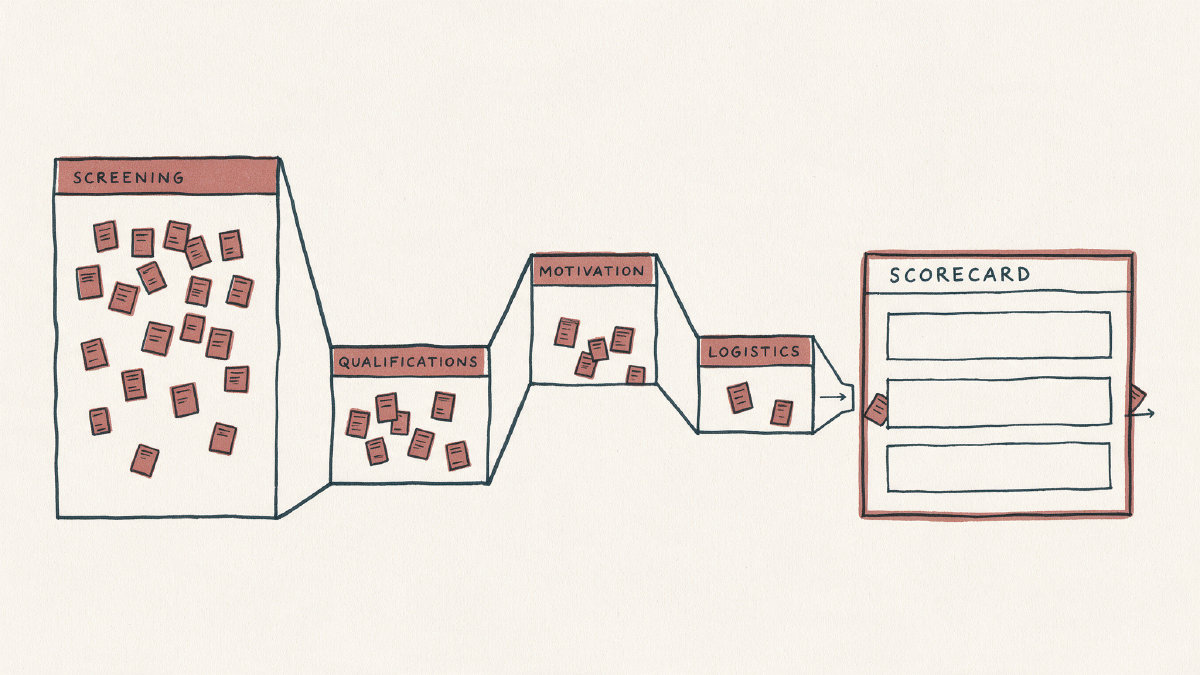
A simple structure looks like this:
Standardized checklist
Must-have requirements
Role-specific competencies
Evidence notes
Behavioral anchors
Knockout criteria
Same-criteria comparison
Human advance/no-advance decision
Wrap-up
What excites you about this role?
Do you have any questions for me?
Is there anything else you’d like to share?
Are you still interested in moving forward with this opportunity?
If the candidate is no longer interested, make sure to capture their feedback and preserve a clear process.