
If you have any doubt about the purpose of decision-making questions during an interview, think about how they are used. Are you preparing for an employment interview, or are you practicing for a government exam? The approach I recommend for employment interviews is to rely mainly on open-ended behavioral questions, while using hypothetical prompts deliberately when they test a specific judgment the role requires.
For the purposes of this guide, I’ll focus on what you might want to consider for an employment interview. After all, we’re not here to prepare you for a government exam’s verbal reasoning section. Instead, we need to think about how these questions can help us evaluate someone’s ability to perform a job.
In this article, I’ll go through the questions we should consider asking when evaluating someone’s ability to make decisions. We’ll also see how we can use those questions as signals that can help us understand their strengths and weaknesses. Finally, I’ll describe how you can adapt the questions and use them as part of a rubric.
Why Behavioral Decision-Making Questions?
The core set of questions I’d like you to ask during interviews are based around the conditions under which a particular role makes decisions. If the role requires the employee to make delayed choices (e.g., whether to take a job or wait for a better offer), then it’s possible that they’ll have made a choice to wait for a better opportunity. Alternatively, if the job is one where employees must make quick decisions based on limited information, then it’s possible that there’s an anecdote where the person had to react quickly.
These kinds of situations aren’t just hypotheticals; instead, you should ask for specific instances where each condition occurred. In many cases, people are asked what they would do, but the best evidence comes from the stories of what they did.
Here are some core behavioral questions that are appropriate for decision making:
Describe an instance where you delayed making a decision
Describe an instance where you had to make a decision with limited information
Describe an instance where you had to make an immediate decision
Describe an instance where you were given multiple options to choose from
Describe an instance where you had to develop your own decision process
Describe an instance where you had to make an unpopular decision on behalf of your team
Describe an instance where you made a decision at your previous job
Do you make better decisions within a group or on your own? Describe an instance that shows why
Describe an instance where you had to prioritize multiple tasks
Describe an instance where you asked for help under a tight deadline
Describe an instance where you made an informed decision that turned out to be wrong
Describe an instance where you made an effective decision
When you’ve chosen your questions, it helps to polish your story so that it’s ready to talk about. Once it’s polished, however, you’ll probably have additional follow-up questions that you’ll use to extract the key points that you’ll use in your evaluation.
What To Look For
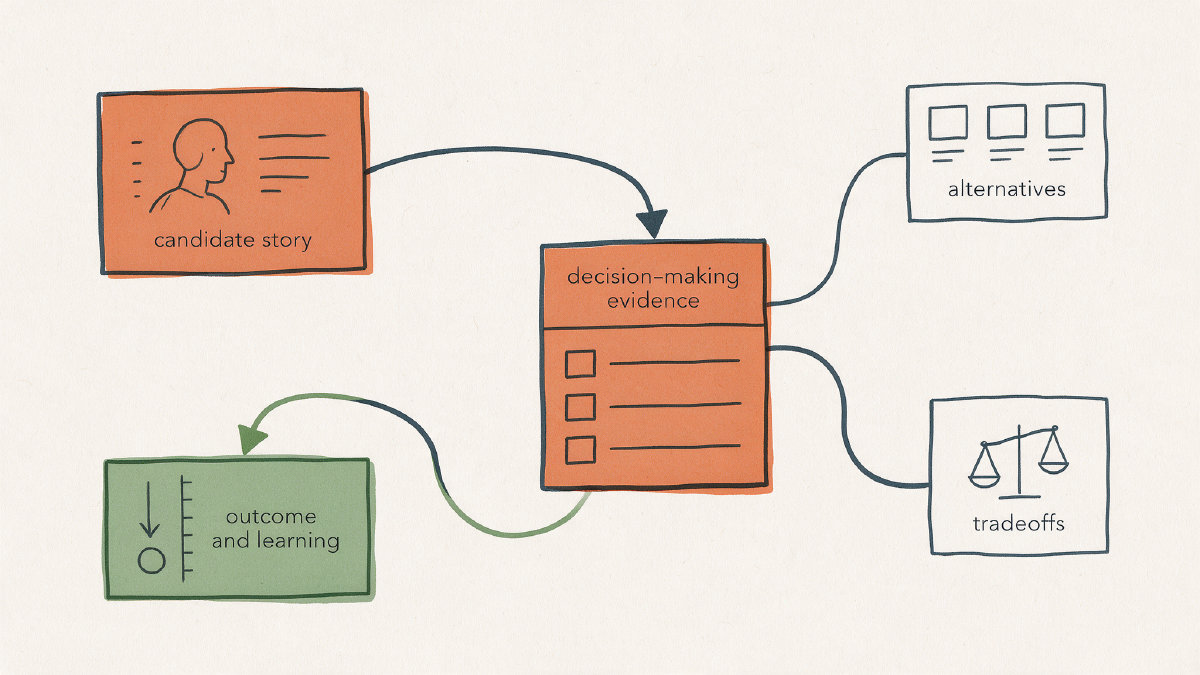
Turn a polished story into a tradeoff discussion by following up until the candidate exposes the choices behind it. Start with probes like “Which alternative option would you have selected, second-best?” or “Why did you prefer the option you selected?” Then test whether the decision needed to happen now: what would happen if they did nothing, whether waiting was possible, and what would change with more information.
Ask what alternatives were rejected and what could make them regret the chosen path. Get the cost of being wrong, the risks at stake, and whether the decision was reversible. If it might need revisiting, ask what milestones, results, or new information would trigger a reassessment. Also ask what data would show the decision’s impact and whether a smaller incremental step would have produced useful insight before a full commitment. Finish with the success test: “How will you later know this was the right decision?”
You’ll need to extract information from the story by asking about what the individual did. Specifically, you want to know:
-
What did they do? Why was it right? Why was it wrong? What were they thinking?
-
What were the consequences of their actions? Were there any unexpected outcomes?
-
What were the alternatives? Did they weigh all of the possibilities before choosing?
-
What were the costs involved in being wrong or right?
Asking such questions will reveal more about their judgment and their ability to think critically.
What strong decision-making evidence looks like
Strong decision-making evidence includes facts or data used to justify the decision. But the decision-maker’s reasoning is important as well. Here are examples that indicate collaboration, ethics, commitment, and other qualities that can affect performance:
-
Facts or data used to support the decision
-
Critical thinking: Alternatives considered, risks and consequences weighed, and the decision evaluated
-
Appropriate help and collaboration: Did the candidate work closely with others?
-
Communication: Was the decision communicated to relevant stakeholders?
-
Ethics and morals: Was the decision ethical?
-
Clear commitment: Was the decision aligned with the company’s goals and values?
-
Goals and success criteria: How will the decision maker determine success?
-
Flexibility and problem-solving: Was the decision maker willing to adjust based on new information?
Positive and negative examples
Positive examples include times when a decision resulted in favorable outcomes, whereas negative examples show mistakes, their consequences, and how the individual learned from the mistake.
What To Watch Out For
Warning signs that justify deeper probing may include gut-only claims, missing alternatives, vague roles, ignored stakeholders, disagreement dismissal, unsupported outcomes, and pure hypotheticals. Some of these are clues, while others are simply clarification points.
Gut instinct only
A claim that a decision was based purely on gut instincts without weighing pros and cons
Quick thinking versus careful weighing
Rapid decision-making without proper consideration
Cannot name evidence or alternatives
The individual isn’t able to cite the actual evidence used to make a decision
Vague outcomes
There are no details about what the outcome was
Exact role clarification
Clarify the role
Specifics and inconsistencies
Discrepancies in the story
Stakeholder effects omitted
What effect did the decision have on others?
No reflection after failure
What was learned?
What they would do, not what they did
This type of question reveals a preference for hypothetical answers over evidence
Follow up, don’t automatically reject
Don’t automatically reject a candidate just because of a hypothetical answer
Adapting Prompts By Role And Decision Stakes
The prompts listed above are generic enough that you could use them across several types of roles. That said, you can tailor them to different levels within the organization.
For managerial or supervisory candidates
Unpopular decisions
Was the decision unpopular? If so, was the person prepared to defend it?
Facts and what is right for the company
Did the person look at facts to determine what is right for the company?
For employees or candidates
Employee or candidate choices
How often has the candidate had to make independent choices?
Delegation and task priority
How did the person decide what to delegate or assign?
Leadership process during pressing issues
Was the leadership process applied correctly?
Willingness to jump in and help
Was the candidate willing to help out in difficult situations?
Individual contributors
Past-work decision authority
Has the person had experience in deciding what to do at work?
Limited data
Did the person have to rely on intuition?
Help-seeking
Has the person sought advice before?
Immediate judgment
Does the person make snap decisions?
Target role operating environment
Can the person describe the decision-making environment of their target role?
Anchored Scoring
I’m going to suggest that you build your scoring system before the interview. You’ll want to define a small number of behaviors or skills that you’ll rate against a scale of poor, acceptable, excellent, etc.
You may want to keep it simple, but if you want to add weightings to each skill, that’s fine too. It doesn’t matter whether you rate on a numerical score or not — what matters is that you have room to note something down.
It’s essential that your scoring is observable and tied directly to job-related behavior. Don’t rate based on feelings or opinions; you can always explain what you mean by “excellent” during the calibration conversation. You can even ask candidates to give examples of things they’ve done before that demonstrate these skills.
Keep your list of job-related anchors simple and consistent. There’s no need to rate every single thing the candidate says and does. Rate independently of the other candidates, and rate against the job requirements. When you’re done, have a brief calibration discussion about the scores and how they fit together.
Remember, the scores are just a way of assessing the candidate’s potential for the position. They shouldn’t ever become an automated hiring-or-rejecting device.
Decisions, Decisions
We’re not here to predict the future, nor are we trying to ensure that our decisions are free from bias. We’re simply offering a set of tools that you can use during your next interview. The tools are a small set of questions designed to assess a particular area of capability: making good decisions. As long as you match the questions to the job, apply disciplined probes, and use objective, evidence-based judgments, you’re off to a good start.