
In this article, I’ll share closed questions examples and show you how to use them in your hiring interviews.
A closed question is one that can be answered with a fixed response. That could be yes/no, true/false, or a specific fact. It could also be multiple-choice, a rating, or a ranking. A closed question isn’t the same thing as an open-ended interview; it’s just a way of asking questions so that the answers are easier to process and compare.
The candidate experience will vary depending on how many closed questions you ask. Closed questions don’t usually get asked during unstructured interviews, but they do come up often in structured interviews. When you’re doing structured interviews, you want to collect consistent data about candidates’ job-related skills and competencies, and closed questions help with that goal.
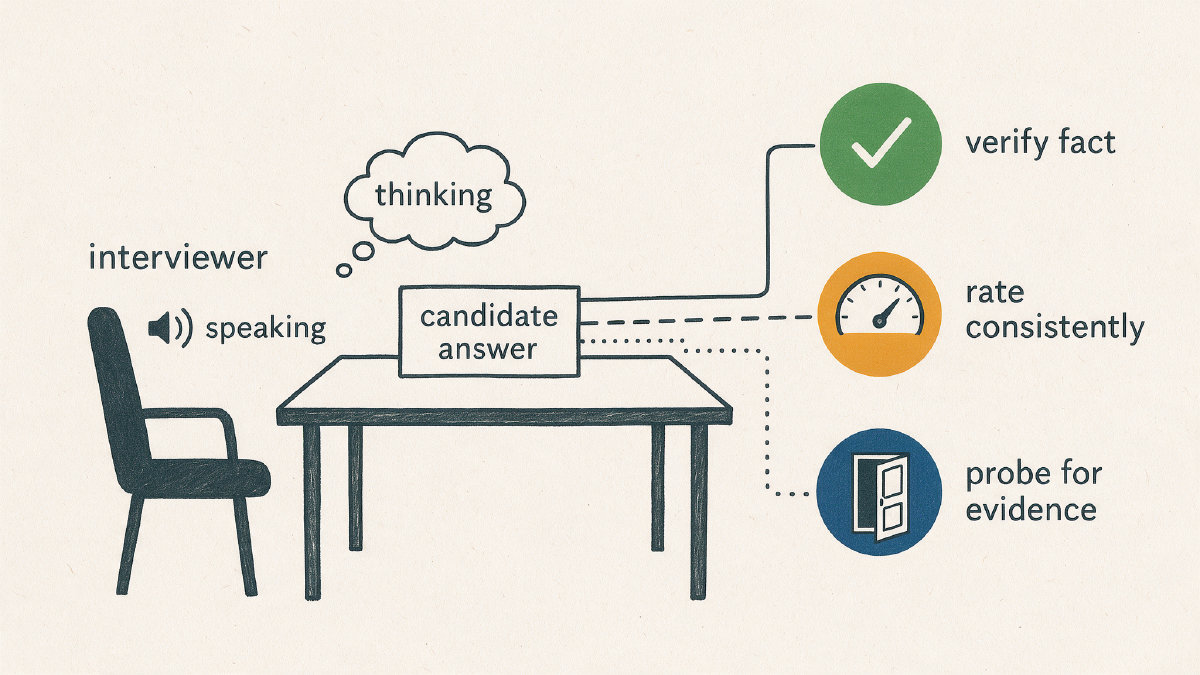
But even when you use closed questions, you shouldn’t treat them like a complete interview method. Instead, you should use them as one tool among many. In particular, if you ask too many closed questions, you might end up oversimplifying complex topics and missing out on important information that candidates may have.
When you use closed questions, you should make sure that they’re relevant to the job. You should also avoid leading or loaded assumptions, and instead ask questions that are neutral and balanced. This means that you should provide every realistic option for a candidate to choose from, and avoid using phrasing that might lead a candidate toward a particular answer.
Finally, remember that closed questions are just one part of the interview process. They should be used in conjunction with other types of questions, such as behavioral and hypothetical questions, to get a more complete picture of each candidate’s abilities and qualities.
Closed questions examples
Let me give you some practical examples of how to use closed questions in your hiring interviews. These are organized by common screen and interview needs:
Work Authorization Status: Do you have work authorization to live and work in the U.S.? (Yes/No)
Role Requirements: Do you have any requirements that would prevent you from performing this role? (Yes/No)
Tools: Do you have experience working with [tool name]? (Yes/No)
Availability: Are you available to start work at [start date]? (Yes/No)
Claimed Experience Levels: How experienced are you with [technology]? (No experience / Basic / Intermediate / Advanced / Expert)
Dichotomous: Have you ever worked in a team environment before?
Multiple-Choice: What type of team environment do you prefer to work in? (In-office / Hybrid / Fully remote)
Rating: On a scale of 1-5, how much do you enjoy working in teams?
Ranking: Rank these team environments in order of preference: in-office, hybrid, fully remote.
Why do you think that?
Could there be an instance where that's not the case?
Why behind a score
Situation
Actions taken
Outcome
Reasoning
Answer choice design
I’ve written about writing good answer choices before, but here are some key considerations:
Use clear, simple wording.
Make sure the options are mutually exclusive.
Include every realistic option.
Avoid leading phrasing.
Balance the positive and negative range.
Define anchors.
Closed responses belong on an interview scorecard only when they are linked to defined scales. For example, if you ask “On a scale of 1-5, how much do you enjoy working in teams?” then you should define what 1 through 5 mean in terms of observable behaviors or outcomes. Then you need to record notes whenever you see something that doesn’t fit your scale. And you should evaluate the responses independently against the job standard, rather than comparing them to other candidates.
Benefits and limitations
Closed questions are most useful when they create fast comparable information. They’re great for confirming facts, routing people into different interview tracks, and ensuring consistency. They also help ensure that everyone gets the same predetermined questions in the same order. The best place to use closed questions is in a structured interview, where they can be combined with other methods of collecting evidence.
If you use closed questions, you should make sure that they’re appropriate for the job. Closed questions can sometimes oversimplify complex topics. Candidates may miss out on new ideas that they wouldn’t otherwise have had the chance to mention. Candidates may feel forced to pick the closest fit answer rather than expressing their true perspective. In some cases, candidates may even feel socially pressured to respond a certain way.
You should also avoid asking closed questions that are unrelated to the job. Avoid making assumptions that aren’t directly related to the job. Ask questions that are neutral and balanced, rather than leading or loaded.
Closed questions are just one part of the interview process. They should be used in conjunction with other types of questions, such as behavioral and hypothetical questions, to get a more complete picture of each candidate’s abilities and qualities.
Practical operating pattern
Here’s a practical operating pattern for interviewers who want to incorporate closed questions into their hiring interviews:
Ask a closed question to establish the fact.
Capture the fixed response consistently.
Then probe only the answers where evidence or judgment must be understood.
Start with the fact you need to establish.
Record the fixed response the same way for every candidate.
Use an open-ended probe when you need evidence or judgment.
Put the evidence on the scorecard.
Evaluate it against the job standard.