
The hiring team approach combines the consistency of a script with the flexibility of an unscripted conversation, which is why examples of semi structured interview questions are useful starting points. This “middle ground” approach has several advantages over either extreme: it provides some standardization, but leaves enough room to explore each candidate’s responses.
How Semi Structured Interviews Work
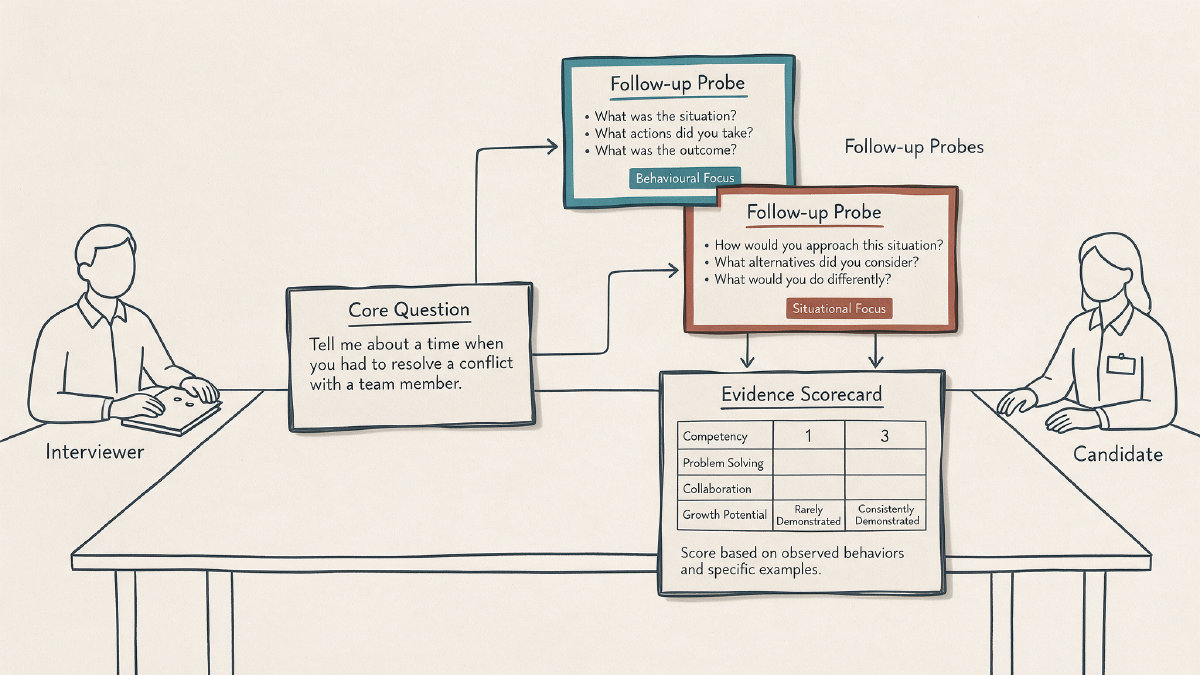
A semi-structured interview typically includes a guide containing short guiding questions that are intended to elicit responses on the same core issues across candidates, even if they’re phrased differently. Probes follow naturally from a response and may be used to clarify or expand on any particular point. A good example of this would be a question like “Tell me about a time when you handled a difficult project.” If the response is “Well, I had to work with another department on a project,” the interviewer might ask, “Was there a conflict between departments?” Or “How did you resolve it?”
This article describes how hiring teams can create and adapt behavioral-based interviews for various positions. In addition, the hiring-team approach allows interviewers to test reasoning and choices as well as probe for evidence behind what the applicant says was achieved.
Role Relevant Guiding Questions
Interviews built around a few guiding questions should focus on a role-relevant topic. Interviews based on behavior-based techniques will use the applicant’s experience to determine their abilities. While these interviews have proven effective in identifying suitable hires, they do require planning and execution at all stages.
The guide should include five to ten questions that form the foundation for the entire interview. These questions should be framed in broad, open, neutral, and clear language so that everyone understands them. The interview should start by setting the context for the job before delving into deeper questions that seek evidence that could support or contradict the initial answer.
Using Probes Consistently
In order to evaluate fairly, probes should remain consistent unless different probing methods yield useful details about the job at hand. The competency, core question, evidence notes, and scoring anchor should remain the same throughout the process. Only the probe needs to change to clarify a response or dig more deeply into the issue.
Stronger answers will be specific, including a situation and the actions that were taken. They’ll also show an outcome (e.g., improved customer satisfaction) or describe the reasoning behind a choice made. A weaker answer lacks specifics and will not demonstrate an outcome, often focusing on personal action or leadership instead.
Interview Question Template
Use this compact template to help your hiring team build consistent, flexible interviews tailored to individual roles.
Core Question:
Planned Probes:
Evidence To Capture:
Warning Signs:
Score Anchor (1–4):
Competency (role relevant):