
There are a few different ways to ask candidates about their coding skills during an interview, and useful interview coding examples tend to go beyond simple questions. One approach is to ask them questions that you think they should know. These can be either trivia or puzzles.
These sorts of questions tend to focus on puzzle-solving, and the answers may have a certain pattern of memorization. That doesn’t necessarily reflect the quality of the candidate’s engineering skills; it just reflects what they’ve studied.
But there are better alternatives: using live examples of code to assess the candidate’s skill level in a more realistic setting. I’ll describe how to build those examples below.
Realistic interview coding examples
When I work as an interviewer, I often use prompts that resemble live examples of coding tasks that someone would face in real life — for example, performance debugging, or writing code that preserves a statistical distribution, or even something like parsing messy JSON or CSV files.
This article will walk through each stage of creating such prompts, including how to phrase them so they’re effective signals for hiring managers.
In general, a prompt that resembles a real-life situation invites clarification, discussion, implementation, testing, and so forth. (The latter two represent the most concrete aspects of the problem.) But some of these steps might not make sense until we understand the question better.
So the first step is to pick a prompt that allows us to evaluate multiple aspects of a potential hire. This includes communication, problem solving, technical work, and testing.
Prompt examples
Let’s look at some examples. A common one involves implementing a function to generate a random list of integers within a specified range. However, this isn’t particularly challenging, so I prefer a slightly more complex version instead.
The next example involves a Python function that’s already written, but appears to do something wrong. The challenge is to figure out what’s wrong with the function and then correct it. We also need to ensure that the corrected function performs correctly by providing tests.
Another prompt asks for an Iris species classifier or visualization. In practice, classification algorithms are relatively simple to implement. So the challenge is to produce an output that demonstrates a good understanding of the data.
Parsing CSV or JSON data is another example. While CSV and JSON formats appear to be pretty straightforward, there are many edge cases to consider. In fact, there’s an entire book devoted to JSON and its quirks!
Other examples include:
A rate limiter
Retrying and backoff strategies
A streaming consumer that handles backpressure
A small RAG pipeline
Once again, while these all sound similar, they’re different enough that it’s worth evaluating each one individually.
Staged interview format
What follows is a staged interview that presents one of these problems as an opportunity to collect evidence across several dimensions of engineering competency.
Roughly speaking, the process starts with a warm-up that takes about 10 minutes. During that time, we ask a few basic questions and get the candidate to explain how they’d approach solving the problem. We’re looking for an ability to break down a complex task into manageable chunks.
After that, we dive deeper into the core signal-producing stage of the exercise. Again, the goal here is to find a solution to the problem presented earlier. This is where we can begin collecting evidence across multiple dimensions, including communication, problem solving, and technical competency.
Finally, we extend the exercise only if the previous stages land quickly. At this point, the goal is to explore new areas of the problem space. Are there any interesting patterns to the data? Could we improve our model?
I recommend that you try asking yourself some of the following questions when preparing your own set of prompts for interviews:
What does the function do? How can you confirm that it’s doing that?
Are there other constraints on the inputs? What about the outputs?
Can you explain what’s happening under the hood?
How does your approach compare to existing ones? Why is yours better?
What assumptions did you make when developing your approach?
Now let’s take a look at some specific prompt wording patterns.
Generate Random List
One possible prompt involves generating a random list of integers between 1 and 255. However, this doesn’t seem very interesting. Instead, perhaps we could ask candidates to write a program that generates a random list of numbers with no repeated values, and that has a particular statistical distribution.
Diagnose What Is Wrong
Another option involves asking candidates to diagnose what’s wrong with a given piece of code. For example, perhaps the code seems to work correctly, but doesn’t preserve the distribution of input data.
Preserve Statistical Distribution
Alternatively, we could ask candidates to preserve the statistical distribution of an input list. There are several approaches to this, which vary depending on the type of statistics we’re trying to preserve.
Predict Species of Iris
We could ask candidates to predict the species of an Iris flower, based on measurements of its length and width. This is a classic problem, and there are several different machine learning algorithms that could be used.
Exploration and Inference
Perhaps we could ask candidates to analyze the dataset and identify any interesting patterns. This could involve exploring the data further, making predictions, or inferring the relationships between variables.
Syntax or Logic Errors
We could provide code that contains syntax or logic errors, and ask candidates to fix them. If the code fails to compile, we could ask the candidate to explain why.
CSV and JSON Edge Cases
Finally, we could ask candidates to write a parser for a CSV file or JSON document. However, this is a relatively easy task, so I’m more interested in looking at the edge cases. Can the parser handle unusual data types, or malformed input?
Scorecard signals
When selecting prompts, you’ll want to define the scorecard signals that you’re going to choose. Keep the number small, and make sure that the set applies across communication, problem solving, technical work, and testing. Four to six is probably a good number.
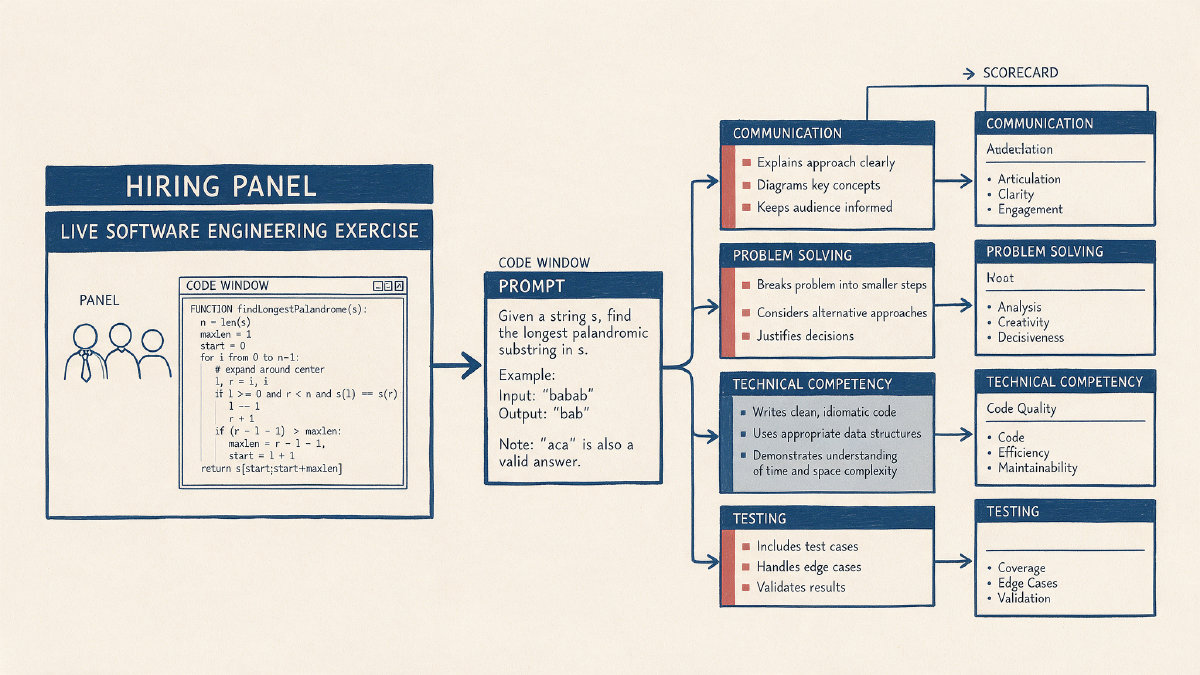
Communication
Problem Solving
Technical Competency
Testing
There are additional considerations too, such as how well the candidate can decompose the problem, and whether they recognize that a problem requires multiple solutions. Code quality and readability are important too, as are trade-offs.
You’ll also want to examine whether the candidate is thinking ahead about the various edge cases, such as what happens to the algorithm when the input is empty. Do they demonstrate a natural instinct for debugging?
In short, you’re trying to see how well the candidate thinks about the problem and works through it, without being handed the solution.
You’ll want to keep track of the probes that you use to deepen the evidence. These can range from questions about assumptions and trade-offs to specific boundary conditions. Don’t hand over the solution outright, however; rather, ask questions that will encourage the candidate to think more deeply about the problem.
For instance, the following are all excellent probes:
State your assumptions.
Explain your trade-offs.
What about boundary conditions?
Time and space complexity?
What’s a typical case, and what’s a corner case?
What’s your hypothesis about what went wrong, and why?
Smallest useful nudge: You can help guide a stuck candidate with the smallest possible change, nudging them along toward the solution.
Warning behaviors
On the other hand, there are warning behaviors that should raise red flags during the session. These don’t automatically trigger a rejection, but are simply pieces of observed evidence that can be tied directly to the rubric dimensions.
Some of the warning behaviors include:
Codes before explaining the approach.
Needs major hints to proceed.
Multiple syntax errors.
Multiple logic errors.
Fails to test the typical cases.
Misses obvious corner cases.
Cannot self-correct bugs.
Cannot communicate reasoning effectively.
Reusable rubric
It’s possible to build a reusable rubric for these exercises by pairing a small set of dimensions with observable band anchors. Once again, four to six dimensions sounds appropriate.
You’ll need to decide on the bands for each dimension, and separate the evidence from an overall human recommendation.
Communication
Problem Solving
Technical Competency
Testing
You’ll also want to decide on a rating system. Strong hire, hire, no hire, and strong no hire are my preferred options. There’s also an optional indecision band to account for those times when you just aren’t sure.
Putting it all together, the rubric becomes a full package of evidence that can be reviewed by a human.
The next step is to run the round consistently. From setup to debrief, everything must be structured to allow consistent collection of evidence, and a fair evaluation of the evidence.
Start by explaining the format of the exercise. Then, state the rules. State what is being scored. Be clear on expectations, and explain what will happen if the candidate gets stuck. Capture evidence during the session itself. Avoid giving too much help to avoid premature rescue, and then wrap things up with a structured debrief.
During the debrief, the panel should talk through behavior, not scores, and arrive at a human decision.
Role relevance and AI policy
You can choose among a variety of exercises depending on the role, level, and language. Role-relevance matters more than whether you’re borrowing an impressive question or chasing coverage in language, frameworks, or technologies. Remember that there are 42+ languages and frameworks to choose from.
For instance, if you’re interviewing for a position that requires performance debugging skills, you’ll probably want to choose a prompt that relates to that area. But you may not care nearly as much about how well a candidate understands the finer points of Java, C++, or JavaScript.
That said, there are still several factors that affect how well a candidate performs in an interview, including what questions they ask, and how well they interact collaboratively.
Keep in mind that there’s also a growing trend towards AI assistance, especially for programming. Interviewers should make that policy known before the interview begins. They should describe what’s allowed (or disallowed) during the session, and then validate the code that the candidate produces.
AI-assisted work is typically considered cheating, and a lot of interviewers are wary of letting candidates rely on tools to help solve problems. On the other hand, a few interviewers actually prefer that candidates be allowed to use an AI assistant to aid in their work. Either way, there are a few things to watch for:
If you allow AI assistance, observe the process and what the assistant contributes.
If you’re conducting a locked or explicitly “no-AI” assessment, the rules should require closing any copilot or other AI tool before the exercise begins.
You shouldn’t infer that a candidate has cheated simply because they remain silent, or because they type quickly.
As with any job interview, it helps to stick to a practical operating principle: Choose one realistic, staged exercise, define what you’re looking for in advance, and score what the candidate actually did during the collaborative round.
Sources
- How candidates are evaluated in coding interviews at top tech companies | Tech Interview Handbook
- How to lead a coding interview that surfaces real signal. · Metaview Blog
- 30 Python Interview Questions For Tech Interviews ( 2023 )
- 25+ Data Science Interview Questions For Tech Interviews - CoderPad
- Python Skills for a Forward Deployed Engineer Interview